How to Prevent Jet Lag: Complete Science-Based Guide to Beat Jet Lag Fast in 2025
Beat jet lag fast with this science-based guide covering proven strategies, light exposure timing, melatonin use, sleep schedules, and expert tips to prevent and recover from jet lag on any trip.
How to Prevent Jet Lag 2025: Science-Based Strategies to Beat Jet Lag Fast and Enjoy Your Trip From Day One
Jet lag ruins the first 3-7 days of most international trips - but it doesn't have to. With proper preparation and science-based strategies, you can reduce jet lag recovery from a week to 1-2 days, or prevent it almost entirely.
After analyzing circadian rhythm research, consulting sleep specialists, reviewing hundreds of studies on jet lag prevention, and testing strategies across dozens of time zone crossings, we've created the most comprehensive, science-backed jet lag prevention guide available.
This guide covers everything from pre-trip sleep schedule adjustment to strategic light exposure, melatonin timing to in-flight strategies, plus expert advice for every direction of travel and time zone difference.
Whether you're crossing 3 time zones or 12, traveling east or west, flying for business or pleasure, this guide will help you arrive energized, skip the brutal adjustment period, and enjoy every moment of your trip.
Understanding Jet Lag: The Science Behind Why It Happens
What Is Jet Lag (Circadian Rhythm Disruption)
The Science: Your body operates on a 24-hour internal clock called the circadian rhythm, controlled by the suprachiasmatic nucleus (SCN) in your hypothalamus. This biological clock regulates:
- Sleep-wake cycle
- Hormone production (cortisol, melatonin, growth hormone)
- Body temperature fluctuations
- Metabolism and digestion
- Alertness and cognitive function
- Physical performance
What Happens During Jet Lag: When you rapidly cross multiple time zones:
-
Your internal clock stays on home time
- Brain thinks it's 3 AM when local time is 2 PM
- Melatonin released at wrong times
- Cortisol peaks misaligned with local schedule
-
External cues conflict with internal signals
- Sunlight says "be awake" but body says "sleep"
- Meal times don't match hunger signals
- Social schedule contradicts circadian rhythm
-
Body systems desynchronize
- Sleep-wake cycle out of sync with local time
- Digestive system on home schedule
- Temperature regulation off
- Hormone production misaligned
Result: The cluster of symptoms we call "jet lag"
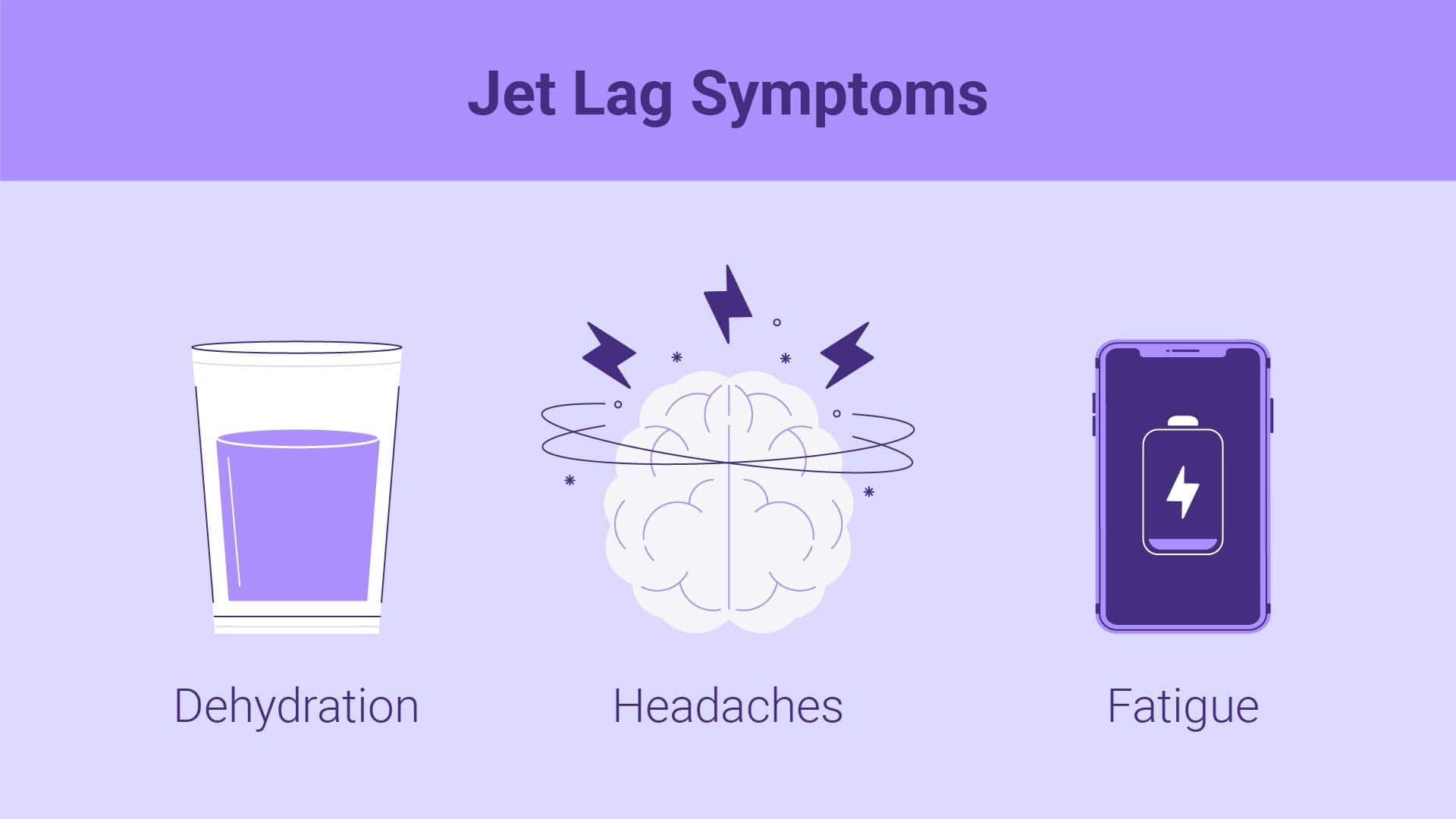
Jet Lag Symptoms (What You're Fighting)
Physical Symptoms:
😴 Extreme fatigue during local daytime
😵 Insomnia at local nighttime
🤕 Headaches
🤢 Digestive issues (constipation, diarrhea, nausea)
😖 Body aches and muscle soreness
💪 Reduced physical performance
🥱 General malaise and weakness
Cognitive Symptoms:
🧠 Difficulty concentrating
😶🌫️ Brain fog and mental sluggishness
😠 Irritability and mood changes
🤔 Poor decision-making
📉 Reduced productivity
😞 Mild depression or anxiety
Severity Factors:
Number of Time Zones:
- 1-2 zones: Minimal/no jet lag
- 3-4 zones: Mild jet lag (1-2 days)
- 5-6 zones: Moderate jet lag (3-4 days)
- 7-8 zones: Significant jet lag (4-5 days)
- 9-12 zones: Severe jet lag (5-7 days)
Direction of Travel:
- Eastward = Harder: Advancing your clock is more difficult
- Westward = Easier: Delaying your clock is more natural
- Why: Natural circadian rhythm is slightly longer than 24 hours (~24.2 hours)
Age Factor:
- Children (under 12): Adapt faster (2-3 days)
- Young adults (20-30): Moderate adaptation (3-4 days)
- Adults (30-60): Slower adaptation (4-6 days)
- Seniors (60+): Slowest adaptation (5-7+ days)
Individual Variation:
- Some people genetically more sensitive to jet lag
- "Morning people" adapt to eastward travel better
- "Night people" adapt to westward travel better
- Overall health impacts adaptation speed
Recovery Time Without Intervention
The Standard Recovery Rate: ~1 day per time zone crossed (without intervention)
Examples:
- New York → London (5 hours): 5 days to fully adjust
- Los Angeles → Paris (9 hours): 9 days recovery
- New York → Tokyo (14 hours): 14 days recovery
- Sydney → Los Angeles (19 hours): 19 days to adjust
Eastward vs Westward:
- Eastward: Standard rate (1 day/zone)
- Westward: 0.75 days/zone (25% faster)
Why This Matters:
- 7-day Europe trip: Spend 5 days jet lagged = only 2 good days
- 10-day Asia trip: Entire trip impacted by jet lag
- Business trips: Poor performance during critical meetings
The Goal of Prevention: Reduce recovery time from 5-7 days to 1-2 days (or prevent entirely)
The 5 Golden Rules of Jet Lag Prevention
Rule #1: Start Adjusting Your Sleep Schedule 3-7 Days Before Departure ⏰
Why This Is Most Important: Pre-trip adjustment gives you a 3-4 hour head start, reducing total adjustment by 3-4 days.
How Much to Adjust:
- Maximum practical shift: 3-4 hours before departure
- Minimum effective shift: 1-2 hours
- Rate: 1 hour per day for 3 days OR 30 minutes per day for 6 days
Eastward Travel (Harder - Going to Bed Earlier):
Example: NYC to London (5-hour difference)
7 Days Before:
- Normal bedtime: 11 PM
- New bedtime: 10:30 PM
- Wake time: 6:30 AM (instead of 7 AM)
6 Days Before:
- Bedtime: 10 PM
- Wake time: 6 AM
5 Days Before:
- Bedtime: 9:30 PM
- Wake time: 5:30 AM
4 Days Before:
- Bedtime: 9 PM
- Wake time: 5 AM
Result: 2-hour head start (reduces 5-day adjustment to 3 days)
Tips for Earlier Bedtime:
✅ Dim lights 2 hours before bed
✅ Avoid screens (blue light suppresses melatonin)
✅ Melatonin 30-60 min before new bedtime (0.5-3mg)
✅ Cool bedroom temperature
✅ Morning bright light to advance clock
Westward Travel (Easier - Staying Up Later):
Example: NYC to Los Angeles (3-hour difference)
3 Days Before:
- Normal bedtime: 11 PM
- New bedtime: 11:30 PM
- Wake time: 7:30 AM (instead of 7 AM)
2 Days Before:
- Bedtime: 12 AM
- Wake time: 8 AM
1 Day Before:
- Bedtime: 12:30 AM
- Wake time: 8:30 AM
Result: 1.5-hour head start
Tips for Later Bedtime:
✅ Bright light exposure in evening
✅ Stay active in evening
✅ Avoid melatonin (delays clock further)
✅ Caffeine strategically if needed
Realistic Limitations:
⚠️ Can't shift more than 3-4 hours before trip (daily life continues)
⚠️ Work/family schedules limit flexibility
⚠️ Better to shift 2 hours than nothing
Rule #2: Master Strategic Light Exposure (Most Powerful Tool) ☀️
The Science: Light is the strongest zeitgeber (time cue) for circadian rhythm. Proper light exposure can shift your clock 1-3 hours per day.
How Light Affects Circadian Rhythm:
- Morning light: Advances clock (makes you wake earlier)
- Evening light: Delays clock (makes you stay up later)
- Brightness matters: 10,000 lux (sunlight) >> 300 lux (indoor light)
Core Principle: Get bright light when you want to be awake. Avoid light when you want sleep to approach.
Eastward Travel (Advancing Clock):
Goal: Make your clock think it's later than it is
Light Strategy:
✅ Get morning sunlight immediately upon arrival (6-10 AM local time)
✅ 30-60 minutes bright light exposure
✅ Go outside, don't just look through window
✅ Even cloudy day provides 10,000+ lux
✅ Avoid evening light (6-10 PM local time)
✅ Wear blue-blocking glasses after 6 PM
✅ Dim indoor lights
✅ No screens before bed (or use blue light filter)
Example: NYC to London (5-hour difference)
- Arrive London 8 AM → Immediately get outside for 60 min walk
- Sunny morning exposure advances clock
- After 6 PM → Sunglasses/dim lights/avoid screens
- Result: 2-3 hour shift first day
Westward Travel (Delaying Clock):
Goal: Make your clock think it's earlier than it is
Light Strategy:
✅ Get evening sunlight (4-8 PM local time)
✅ 30-60 minutes bright light
✅ Delays clock, makes you stay up later naturally
✅ Avoid morning light first day (controversial but effective)
✅ Wear sunglasses if must go outside early morning
✅ Stay indoors with curtains closed until late morning
✅ Let yourself sleep in if possible
Example: NYC to LA (3-hour difference)
- Arrive LA afternoon → Get outside 5-7 PM for sunset walk
- Evening light delays clock
- First morning → Sleep in until 9-10 AM local (normal wake time on your clock)
- Result: 1-2 hour shift first day
Light Therapy Lamp (If Sunlight Unavailable):
- Brightness: 10,000 lux minimum
- Duration: 20-30 minutes
- Timing: Use as substitute for sunlight at strategic times
- Cost: $30-$100
- Brands: Verilux, Carex, Philips
Blue Light Blocking Glasses:
- Use: Evening to avoid light delaying clock
- When: 2-3 hours before desired bedtime
- Cost: $15-$60
- Effectiveness: Blocks 65-99% blue light
Rule #3: Use Melatonin Strategically (Not Just "Take Before Bed") 💊
What Melatonin Does:
- Hormone that signals "time to sleep"
- Naturally produced by pineal gland when dark
- Supplements provide external dose
- Two effects: 1) Makes you sleepy, 2) Shifts circadian rhythm
The Key: WHEN you take it determines the effect
Melatonin Timing for Jet Lag:
Eastward Travel (Advance Clock):
- Take: 30-60 min before desired bedtime AT DESTINATION
- Dose: 0.5-5mg (most people: 1-3mg effective)
- Duration: First 3-5 nights at destination
- Effect: Helps you fall asleep earlier + advances clock
Example: NYC to London
- London bedtime target: 10 PM
- Take melatonin: 9-9:30 PM London time
- Do this: First 3-4 nights
Westward Travel (Delay Clock):
- Generally DON'T take melatonin (delays clock MORE, opposite of goal)
- Exception: If struggling to sleep at local bedtime after 2-3 days, low dose (0.5mg) acceptable
- Better: Use light exposure instead
Optimal Dosing:
- Start low: 0.5-1mg (surprisingly effective)
- Typical dose: 1-3mg
- Maximum: 5mg (higher doesn't help more, may cause grogginess)
- Form: Fast-dissolving tablets work fastest
Timing Precision Matters:
- Take 30-60 min before sleep (not earlier)
- Consistent timing each night
- Combined with dim lights, no screens
Side Effects to Know:
- Morning grogginess (if dose too high)
- Vivid dreams (common, harmless)
- Headache (rare)
- Next-day drowsiness (if timing off)
Who Shouldn't Use:
⚠️ Pregnant/breastfeeding (consult doctor)
⚠️ Children (consult pediatrician)
⚠️ On certain medications (check interactions)
⚠️ Autoimmune disorders (consult doctor)
Where to Buy:
- Available OTC in USA, Canada, some countries
- Prescription required: UK, most of Europe, Australia
- Bring from home if destination requires prescription
Pro Tips:
✅ Test at home first (see how you react)
✅ Start with low dose (0.5-1mg)
✅ Take at same time each night
✅ Combine with sleep hygiene (dark room, cool temp)
✅ Stop after 5 days (circadian rhythm adjusted)
Rule #4: Adjust Meal Times to Destination Schedule 🍽️
Why Meal Timing Matters: Eating is a powerful circadian rhythm cue ("zeitgeber"). Your digestive system has its own clock.
The Science:
- Insulin and blood sugar fluctuations signal time of day
- Digestive hormones follow circadian pattern
- Eating at "wrong" times confuses body clock
- Fasting periods can help reset rhythm
Strategy:
On Flight:
✅ Eat according to DESTINATION meal times (not home time)
✅ Set watch to destination time immediately upon boarding
✅ Breakfast when it's breakfast at destination
✅ Skip meals that don't align with destination schedule
Example: Overnight Flight NYC to London
- Depart NYC: 7 PM
- Arrive London: 7 AM next morning
- On plane at 11 PM NYC time = 4 AM London time
- Skip late dinner service (not aligned)
- Sleep instead
- Accept breakfast service at 6 AM London time
- Result: Eating on London schedule from moment of arrival
Upon Arrival:
✅ Force yourself to eat at local meal times (even if not hungry)
✅ Breakfast when locals eat breakfast
✅ Lunch at local lunch time
✅ Dinner at local dinner time
✅ Avoid eating at "home time" meal hours
The Fasting Hack (Advanced): Some research suggests 12-16 hour fast before arrival helps reset:
- Stop eating 16 hours before destination breakfast time
- Example: Land 8 AM, want breakfast → Fast from 4 PM day before
- Controversial but some swear by it
- Not for everyone (low blood sugar, diabetes, etc.)
What to Eat:
✅ Protein-rich breakfast → Promotes wakefulness
✅ Balanced lunch → Sustained energy
✅ Carb-rich dinner → Promotes sleep
✅ Avoid: Heavy meals close to bedtime, excessive alcohol, too much caffeine
Rule #5: Stay Awake Until Local Bedtime on Arrival Day (No Naps!) 😴
The Critical First Day: How you handle arrival day determines adjustment speed.
The Golden Rule: Absolutely NO NAPS on arrival day (except tiny power nap if desperate)
Why No Naps:
- Napping reinforces home sleep schedule
- Makes nighttime sleep harder
- Delays circadian shift
- One 3-hour nap can set you back 2-3 days
The Strategy:
If Arriving Morning/Midday:
✅ Force yourself to stay awake until reasonable local bedtime (9-11 PM)
✅ Get outside immediately (sunlight exposure)
✅ Walk around, explore, stay active
✅ Light meals (avoid heavy food making you sleepy)
✅ Caffeine strategically (morning/early afternoon only)
✅ Social interaction (harder to fall asleep talking to people)
If Desperate (Absolutely Cannot Stay Awake):
⚠️ Power nap ONLY: 20 minutes maximum
⚠️ Before 2 PM local time (later disrupts night sleep)
⚠️ Set alarm (don't trust yourself)
⚠️ Coffee nap: Drink coffee, nap 20 min, wake energized (caffeine kicks in as you wake)
What Makes Staying Awake Easier:
✅ Bright sunlight (walk outside)
✅ Cold shower
✅ Physical activity (walking tour, gym)
✅ Social plans (hard to fall asleep at dinner)
✅ Caffeine (strategically, not after 2 PM)
✅ Avoid: Lying down, dim rooms, heavy meals, alcohol
Go to Bed at Reasonable Local Time:
✅ 9-11 PM local (not 6 PM, even if exhausted)
✅ Normal bedtime routine
✅ Dark, cool room
✅ Melatonin if eastward travel
✅ Accept you'll wake early first night (normal)
First Night Sleep:
- Likely won't be perfect
- May wake at 3-4 AM (body thinks it's morning)
- Don't stress - this is normal
- Stay in bed, rest even if not sleeping
- Don't check phone/turn on lights (reinforces awakeness)
- Usually improve night 2-3
Complete Pre-Flight Jet Lag Prevention Protocol
3-7 Days Before Departure
Task List:
Sleep Schedule Adjustment:
✅ Calculate time difference
✅ Determine if eastward or westward travel
✅ Shift sleep 30-60 min per day toward destination time
✅ Maximum 3-4 hour shift before departure
Light Exposure Prep:
✅ Eastward: Morning bright light, evening dim lights
✅ Westward: Evening bright light, avoid early morning light
✅ Consider purchasing light therapy lamp
✅ Get blue light blocking glasses
Melatonin Acquisition:
✅ Purchase melatonin (0.5-5mg tablets)
✅ Test at home (see how you react)
✅ Pack in carry-on
✅ Verify destination rules (prescription required in some countries)
General Preparation:
✅ Well-rested (catch up on any sleep debt)
✅ Healthy diet (good nutrition aids adaptation)
✅ Exercise regularly (improves sleep quality)
✅ Reduce stress (stress impairs adjustment)
✅ Avoid alcohol excess (disrupts sleep)
Day Before Departure
Critical Tasks:
✅ Sleep well - Don't stay up late packing!
✅ Set watch to destination time - Start thinking in new timezone
✅ Hydrate well - 2-3 liters water
✅ Avoid alcohol - Dehydrates, disrupts sleep
✅ Pack sleep aids - Eye mask, earplugs, neck pillow
✅ Pack melatonin - In carry-on
✅ Review arrival plan - Know sleep/wake strategy
Mental Preparation:
✅ Accept first day will be challenging
✅ Commit to staying awake until bedtime
✅ Plan activities to keep you awake
✅ Have backup plan if extremely tired (20-min nap limit)
In-Flight Jet Lag Prevention Strategies
Immediately Upon Boarding
Critical First Step:
✅ Set watch to destination time
✅ Start thinking in destination timezone
✅ Decide sleep/wake plan based on arrival time
Decision Matrix:
If Arriving Morning/Midday at Destination:
- Goal: Sleep on plane (mimics nighttime)
- Strategy: Try to sleep 6-8 hours during flight
If Arriving Evening/Night at Destination:
- Goal: Stay awake on plane (mimics daytime)
- Strategy: Watch movies, work, read - NO SLEEPING
Sleep Strategy on Plane
For Overnight Flights (Arriving Morning):
Maximize Sleep Quality:
✅ Timing: Sleep during destination "night hours"
✅ Seat recline - As far as comfortable
✅ Eye mask - Block all light
✅ Earplugs or noise-canceling headphones - Block sound
✅ Neck pillow - Prevent sore neck
✅ Blanket/layers - Cabin temperature varies
✅ Melatonin - 0.5-3mg, 30 min before desired sleep
Avoid Sleep Disruptions:
❌ Don't drink too much water right before sleep (bathroom trips)
❌ Skip alcohol (disrupts sleep quality)
❌ Limit caffeine (if sleeping in next 4 hours)
❌ Avoid heavy meals (indigestion disrupts sleep)
❌ Don't watch stimulating content right before sleep
If Can't Sleep:
- Don't stress (rest is better than nothing)
- Close eyes, relax muscles
- Avoid bright screens
- Light reading acceptable
- Low-dose melatonin might help
For Daytime Flights (Stay Awake):
Stay Alert Strategies:
✅ Watch movies/TV - Engaging content
✅ Work/read - Productive use of time
✅ Walk aisle frequently - Every 1-2 hours
✅ Socialize - Talk to travel companion
✅ Caffeine strategically - Coffee, tea
✅ Stay hydrated - Water keeps you alert
✅ Snack - Avoid heavy meals making you drowsy
Avoid:
❌ Don't recline seat (invites sleep)
❌ No eye mask
❌ No melatonin
❌ Don't watch calming content
Hydration is Critical
Why Hydration Matters for Jet Lag:
- Cabin air 10-20% humidity (desert-level dryness)
- Dehydration worsens jet lag symptoms
- Impairs cognitive function
- Increases fatigue
- Makes sleep adjustment harder
Hydration Goals:
✅ 8oz water per hour of flight
✅ Long-haul (10 hours) = 80oz water (2.4 liters)
✅ Start hydrating day before flight
Hydration Strategy:
✅ Drink water every hour (set alarm)
✅ Accept every water service
✅ Bring empty bottle through security, fill after
✅ Request water from crew between services
✅ Drink water with meals
Avoid Dehydration:
❌ Alcohol - Massively dehydrating, disrupts sleep
❌ Excessive caffeine - Mild diuretic (some coffee okay, don't overdo)
❌ Salty foods - Increase water retention, bloating
The Alcohol Trap: Many travelers drink alcohol to sleep on flights:
- Problem: Alcohol disrupts sleep quality
- Sleep stages altered (less REM, less restorative)
- Dehydration worsens jet lag
- Grogginess upon arrival
- Verdict: Avoid alcohol on flights (or max 1 drink)
Movement & Circulation
Why Movement Matters:
- Prevents DVT (deep vein thrombosis - blood clots)
- Reduces stiffness and soreness
- Improves circulation
- Maintains alertness (if staying awake)
- Reduces jet lag severity
Movement Schedule:
✅ Walk aisle every 2 hours minimum
✅ Stand and stretch - Every 1-2 hours
✅ Ankle circles and leg lifts while seated
✅ Shoulder rolls, neck stretches
✅ Aisle-side seat - Easier to get up without disturbing others
Seated Exercises:
✅ Ankle flexes and circles (30 reps each direction)
✅ Knee lifts (raise each knee 10 times)
✅ Seated march (alternating legs, 1 minute)
✅ Shoulder shrugs and rolls
✅ Neck gentle side-to-side stretches
✅ Wrist and hand exercises (especially if working)
Compression Socks:
✅ Reduce DVT risk
✅ Minimize leg swelling
✅ Improve circulation
✅ Recommended: 15-20 mmHg compression
✅ Put on before flight
Meal Strategy on Plane
Follow Destination Meal Times:
✅ Set watch to destination time
✅ Eat when it's meal time at destination
✅ Skip meals that don't align
What to Eat:
✅ Light meals - Heavy food makes you sleepy, harder to digest
✅ Protein and complex carbs - Sustained energy
✅ Vegetables/fruit - Hydrating, nutritious
✅ Avoid: Excessive salt, fried food, heavy sauces
What to Avoid:
❌ Heavy meals before desired sleep - Indigestion
❌ Excessive salt - Water retention, bloating
❌ Gas-producing foods - Beans, carbonated drinks (cabin pressure makes worse)
❌ Unknown foods - Risk of food sensitivity/upset stomach
Strategic Eating:
- If trying to sleep: Very light snack or skip late meal
- If staying awake: Regular light meals maintain energy
- Breakfast service before landing: Eat it (signals morning to body)
Post-Arrival Jet Lag Recovery Protocol
First 24 Hours (Most Critical)
Upon Landing:
✅ Set all devices to local time (if not already)
✅ Start operating on local schedule immediately
✅ No more thinking in home time
Morning/Midday Arrival Strategy:
Goal: Stay awake until reasonable local bedtime
Hour 1-2 (Arrival, Immigration, Transport):
✅ Move through airport - Walking helps alertness
✅ Fresh air when exiting airport
✅ Bright sunlight exposure starts now
First Activity (Critical):
✅ Get outside immediately - 30-60 min sunlight exposure
✅ Walk around neighborhood
✅ Don't go to hotel room and lie down (temptation to nap!)
✅ Drop bags, immediately back outside
Morning/Afternoon (Hours 3-8):
✅ Stay active and outside
✅ Walking tour (combines exercise, sunlight, engagement)
✅ Light sightseeing (nothing too demanding)
✅ Café stops (social, caffeinated)
✅ Avoid: Hotel room, lying down, quiet dark places
Caffeine Strategy:
✅ Coffee/tea okay until 2 PM local time
✅ Use strategically when energy crashes
✅ Stop by early afternoon (prevents night sleep disruption)
Meal Schedule:
✅ Lunch at local lunch time - Even if not hungry
✅ Light meal (avoid heavy food making you sleepy)
✅ Hydrate continuously
Afternoon (Hours 8-12):
✅ This is HARDEST time (3-6 PM local, body wants sleep)
✅ Stay outside, keep moving
✅ Social activities (harder to fall asleep talking)
✅ Light exercise (walk, swim)
✅ Power nap if absolutely necessary: 20 min max, before 2 PM
Evening (Hours 12-15):
✅ Dinner at reasonable local time (6-8 PM)
✅ Light activity after dinner (short walk)
✅ Wind down routine starts (8-9 PM)
Pre-Bedtime (1-2 Hours Before Sleep):
✅ Dim lights in accommodation
✅ Avoid screens (or use blue light filter)
✅ Cool shower/bath (drops body temp, signals sleep)
✅ Melatonin 30-60 min before bed (if eastward travel)
✅ Reading, light stretching
Bedtime:
✅ Go to bed 9-11 PM local (reasonable time, not 6 PM even if exhausted)
✅ Dark room (blackout curtains, eye mask)
✅ Cool temperature (65-70°F / 18-21°C)
✅ Quiet (earplugs if needed)
First Night Expectations:
- Probably won't sleep perfect 8 hours
- May wake at 3-4 AM (body thinks it's daytime)
- What to do if you wake: Stay in bed, rest, don't check phone, don't turn on lights
- Light reading okay (dim reading light)
- Don't stress - night 2-3 improve dramatically
Evening Arrival Strategy:
If Arriving 6-11 PM Local:
✅ Go to hotel, normal bedtime routine
✅ Light dinner if hungry
✅ Quick walk if energized
✅ Wind down, bed by 10-11 PM
Avoid:
❌ Drinking heavily to "celebrate arrival"
❌ Staying up super late exploring
❌ Sleeping immediately at 6 PM (too early)
Days 2-5: Reinforcement Phase
Continue Core Strategies:
✅ Wake at consistent time - Even if tired, get up at same time
✅ Morning sunlight - 30 min every morning (eastward travel)
✅ Evening sunlight - If westward travel
✅ Regular meal times - Eat at local schedule
✅ Exercise - Daily movement (walk, gym, swim)
✅ Melatonin at bedtime - First 3-5 nights if needed
Sleep Improvement Timeline:
- Day 1: Hardest, may wake middle of night
- Day 2: Noticeable improvement, sleeping better
- Day 3: Significant improvement, mostly adjusted
- Day 4-5: Nearly back to normal
- Day 6-7: Fully adjusted (for 5-7 zone crossings)
When to Stop Melatonin:
✅ After 5 days usually
✅ Once sleeping normally at local time
✅ Gradually reduce dose (3mg → 1mg → stop)
Exercise Timing:
- Morning: Promotes wakefulness, advances clock (eastward)
- Afternoon: Moderate activity, safe anytime
- Evening: Light only (yoga, walking), avoid intense 3 hours before bed
Special Situations
Short Trips (2-3 Days): Should you even adjust?
- If 2-3 day trip, 1-2 hour difference: Don't fully adjust
- Stay closer to home schedule
- Use coffee/naps to power through
- Only worth full adjustment if 4+ days
Multiple Time Zone Trip:
- Adjust to each new location (1-2 days per stop)
- Or maintain schedule from first destination through similar zones
Return Trip:
- Same strategies apply for returning home
- Often easier (returning to familiar environment)
- Use light exposure, melatonin, sleep schedule
Advanced Jet Lag Hacks & Tips
The Argonne Anti-Jet Lag Diet (Alternative Approach)
What It Is: Developed by Argonne National Laboratory, 4-day feast-fasting cycle before travel.
How It Works: Alternating high-protein/high-carb days with light eating supposedly helps reset circadian rhythm.
The Protocol:
- Day 1 (4 days before): Feast - High protein breakfast/lunch, high carb dinner
- Day 2 (3 days before): Fast - Very light meals, salads, soups
- Day 3 (2 days before): Feast - High protein breakfast/lunch, high carb dinner
- Day 4 (1 day before): Fast - Very light meals
- Travel day: Feast at destination meal times
Does It Work?
- Some studies show 70%+ reduction in jet lag
- Highly structured, difficult to follow
- Not for everyone (requires planning, dietary flexibility)
- Anecdotal reports range from "life-changing" to "no effect"
Our Take: Worth trying if you're disciplined and have time to plan. Most people find basic strategies (light, melatonin, sleep schedule) easier and effective enough.
Stopover Strategy
For Extreme Time Differences (12+ Hours): Breaking journey with 2-3 day stopover allows partial adjustment.
Example: NYC to Sydney (15-hour difference)
- Direct flight: 7-10 days full adjustment
- Stopover Hawaii 3 days (5-hour adjustment) + Continue Sydney (10-hour adjustment)
- Each stopover: 2-3 days partial adjustment
- Total adjustment easier in stages
Benefits:
✅ Less severe jet lag at final destination
✅ Bonus: Visit extra destination
✅ Break up exhausting long flight
Drawbacks:
❌ More travel time
❌ Additional cost
❌ More logistics
Best For: Long-term relocations, sabbaticals, those who adjust slowly to jet lag
Red-Eye Flight Optimization
What Is Red-Eye: Overnight flight departing late evening, arriving early morning.
Why It's Good for Jet Lag:
- Departs when you'd normally sleep
- Arrive morning (start day on local schedule)
- Skip first difficult staying-awake day
How to Optimize:
✅ Sleep entire flight if possible
✅ Arrive ready to start local day
✅ Immediate sunlight exposure upon arrival
✅ Straight into morning routine
Challenges:
- Hard to sleep well on planes
- Arrive exhausted (vs rested if slept in hotel)
- First day can be very hard
Best For: Those who can sleep on planes, short trips where you can't afford adjustment time
Jet Lag Apps
Timeshifter:
- Cost: $10 per trip (or subscription)
- What it does: Personalized light exposure and sleep schedule
- Based on: Circadian rhythm research
- Input: Flight details, sleep preferences
- Output: Hourly recommendations (seek light, avoid light, nap, caffeine, melatonin)
- Reviews: 4.8/5, many swear by it
- Worth it? Yes for complex trips or those who want detailed plan
Jet Lag Rooster:
- Cost: Free basic, $5 premium
- What it does: Calculates optimal pre-trip adjustment plan
- Simpler than Timeshifter
- Worth it? Good free option
Entrain:
- Cost: Free
- Research-based (University of Michigan)
- Light exposure scheduling
- Worth it? Good free research-backed option
Jet Lag by Common Routes
Easy (1-3 Hour Difference):
- East Coast ↔ West Coast US: Minimal adjustment needed
- Europe within continent: 1-2 hours max
- Strategy: Minimal preparation, adjust day 1
Moderate (4-6 Hours):
- US East Coast ↔ Europe: 5-6 hours
- US West Coast ↔ Hawaii: 3-5 hours
- Strategy: Full prevention protocol, 2-3 day adjustment
Challenging (7-9 Hours):
- US West Coast ↔ Europe: 9 hours
- US ↔ Middle East: 7-8 hours
- Strategy: Aggressive pre-trip adjustment, all strategies, 3-5 day adjustment
Severe (10-15 Hours):
- US ↔ Asia: 12-14 hours
- US ↔ Australia: 15-19 hours
- Strategy: Maximum preparation, consider stopover, 5-7+ day adjustment
Frequently Asked Questions
Q: How long does jet lag last if I do nothing to prevent it?
A: Approximately 1 day per time zone crossed (eastward) or 0.75 days per zone (westward). NYC to London (5 hours) = 5 days to fully adjust. NYC to Tokyo (14 hours) = 14 days to fully recover. Without intervention, you'll spend the majority of short trips feeling off. This is why prevention strategies are so valuable - they can cut recovery time by 50-75%.
Q: Is jet lag worse flying east or west?
A: Eastward is harder (advancing your clock) vs westward (delaying clock). Your natural circadian rhythm is slightly longer than 24 hours (~24.2 hours), so delaying (westward) is easier than advancing (eastward). Eastward: 1 day recovery per zone. Westward: 0.75 days per zone. Example: NYC to London (eastward, 5 hours) takes 5 days. London to NYC (westward, 5 hours) takes 3-4 days.
Q: Can I completely prevent jet lag?
A: Significant reduction is realistic; complete prevention is difficult. With aggressive strategies (pre-trip adjustment, light exposure, melatonin, arrival protocol), you can reduce 7-day adjustment to 1-2 days. Complete prevention possible for 2-4 hour differences. Larger differences (8+ hours): Expect 2-3 days mild symptoms even with perfect protocol. Realistic goal: functional day 1, mostly recovered day 2-3 instead of miserable for a week.
Q: Should I adjust to destination time before I leave or after I arrive?
A: Both - pre-trip adjustment (3-4 hours max) PLUS post-arrival strategies. Pre-trip gives you head start, but you can't fully adjust before leaving (daily life continues). Shift 1 hour per day for 3 days before departure, then complete adjustment after arrival using light exposure, melatonin, and staying awake until local bedtime. Combined approach reduces total adjustment time by 50%+.
Q: Does melatonin really work for jet lag?
A: Yes - extensive research confirms effectiveness, especially for eastward travel (advancing clock). Key is timing: Take 30-60 min before desired bedtime at destination for first 3-5 nights. Dose: 0.5-5mg (most people need 1-3mg). Helps you fall asleep earlier AND shifts circadian rhythm. Don't take for westward travel (delays clock opposite direction). Not magic solution alone - combine with light exposure and sleep schedule adjustment.
Q: Is it better to sleep or stay awake on the flight?
A: Depends on arrival time. Arriving morning/midday: Sleep on flight (mimics nighttime), arrive ready to start day. Arriving evening/night: Stay awake on flight (mimics daytime), sleep when you arrive. Set watch to destination time upon boarding and start living on that schedule immediately. Worst approach: Sleep randomly without considering destination time.
Q: Should I take a nap when I arrive if I'm exhausted?
A: NO - Avoid naps on arrival day (extremely important!). Napping reinforces home schedule and delays adjustment by 2-3 days. If absolutely desperate: Maximum 20-minute power nap before 2 PM local. Better strategies: Cold shower, walk outside in sunlight, caffeine, keep moving. The most critical rule: Stay awake until reasonable local bedtime (9-11 PM), even if you're exhausted. First night won't be perfect, but night 2-3 dramatically improve.
Q: Does exercise help with jet lag?
A: Yes - exercise aids circadian rhythm adjustment. Morning exercise (if eastward) advances clock. Light daily activity improves sleep quality, boosts energy, reduces stress. Upon arrival: Walking outside combines exercise + sunlight exposure (powerful combination). Don't overdo it first day (exhaustion backfires), but 30-60 min daily movement significantly helps. Avoid intense exercise 3 hours before bedtime (disrupts sleep).
Q: What's the best seat to minimize jet lag?
A: Aisle seat for easy movement (walk every 2 hours, bathroom access). Window seat if you need to sleep (lean against wall, less disturbed by aisle traffic). Middle seat: Worst for jet lag (can't move easily, disrupted by others). Premium economy/business class helps if affordable (lie flat = better sleep = less jet lag), but strategies matter more than seat class.
Q: Can I drink alcohol on the flight without making jet lag worse?
A: Alcohol significantly worsens jet lag - avoid or minimize. Problems: 1) Dehydrates (cabin air already 10-20% humidity), 2) Disrupts sleep quality (less restorative sleep despite making you drowsy), 3) Impairs circadian adjustment, 4) Causes grogginess upon arrival. If you must drink: Maximum 1-2 drinks, match 1:1 with water, finish 4+ hours before landing. Better choice: Hydrate with water, save drinking for after you've adjusted.
Q: Do jet lag pills/supplements (other than melatonin) work?
A: Limited evidence for most. Melatonin: Strong evidence. No-Jet-Lag homeopathic pills: No scientific evidence (placebo effect). Vitamin B12, magnesium, herbal supplements: Minimal evidence for jet lag specifically. Prescription sleep aids (Ambien, etc.): Knock you out but don't help circadian adjustment, grogginess risk. Best approach: Stick with proven strategies (light, melatonin, sleep schedule) rather than unproven supplements.
Q: How can I minimize jet lag on a short 2-3 day trip?
A: For very short trips (2-3 days, 1-3 hour difference), consider NOT fully adjusting. Stay closer to home schedule, use caffeine/power naps to function during local business hours, return home before full adjustment. Only adjust if: 4+ days trip, critical performance needed (important meeting), or large time difference (6+ hours). For 2-day trip to different coast (3 hours): Stay on home schedule, sleep/wake at weird local times but avoid full adjustment hassle.
Q: Why do I feel worse on day 2-3 than day 1?
A: Adrenaline and novelty mask symptoms day 1. Arrival excitement, new environment, and stress hormones keep you going. Days 2-3: Adrenaline fades, reality of sleep debt hits, circadian rhythm maximally misaligned. This is normal! Days 3-4 usually turn corner as adjustment begins working. Don't give up on strategies day 2 - that's when they matter most.
Q: Does age affect how badly jet lag hits you?
A: Yes - generally worse with age. Children (under 12): Adapt fastest (2-3 days). Young adults (20s-30s): Moderate (3-4 days). Adults (40s-60s): Slower (4-6 days). Seniors (60+): Slowest (5-7+ days). Individual variation matters more than age - some 60-year-olds adjust faster than some 30-year-olds. Older travelers should be extra diligent with prevention strategies.
Q: Can I "bank sleep" before a trip to help with jet lag?
A: Yes and no. You can't "store" sleep for future use, but being well-rested (no sleep debt) before departure helps significantly. Sleep-deprived travelers adjust slower and suffer more. Goal: Normal 7-9 hours nightly week before trip, avoid all-nighter before departure. Don't stay up late packing! Being well-rested provides foundation for successful adjustment, but doesn't replace proper jet lag strategies.
Q: How do flight attendants and pilots deal with jet lag?
A: Most don't fully adjust on short layovers. Strategies: 1) Stay on home base time for quick turnarounds (24-48 hours), 2) Partial adjustment for longer layovers (3-5 days), 3) Strategic napping, 4) Light exposure control, 5) Melatonin use, 6) Experience (body adapts to frequent switching over time). Long-haul crew often struggle with chronic circadian disruption - not a perfect model for occasional travelers. For your 1-2 trips/year: Full adjustment to destination recommended.
Related Travel Health & Insurance Guides:
📚 Travel Insurance & Health Guide 2025 - Complete protection and wellness overview
📚 Best Travel Insurance 2025 - Provider comparison and recommendations
📚 Travel Medical Tips & Health Guide - Stay healthy while traveling
📚 Travel Insurance for Digital Nomads - Long-term coverage for remote workers
Remember: Jet lag is temporary, but poor handling of it can ruin your entire trip. Invest 2-3 hours in preparation and following these strategies to save 5-7 days of suffering. Your future well-rested self will thank you!
Enjoy your trip jet-lag-free! ✈️🌍😴☀️